
Carryover Study in Medical Laboratory | Procedure, Formula & Example
Published 1 month ago
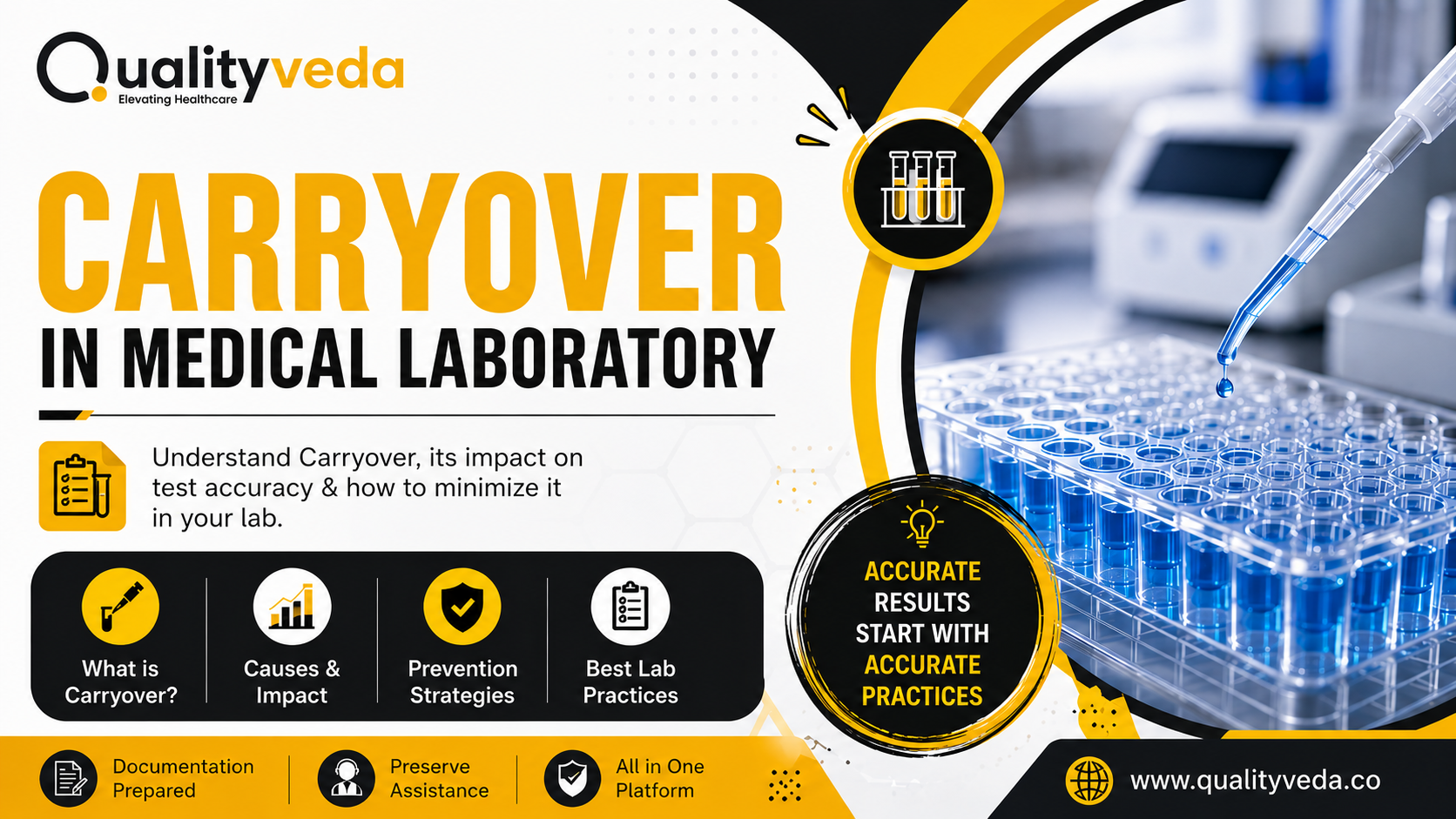
Carryover in a medical laboratory is the unintended transfer of a small amount of sample or reagent from one test to the next, which can alter the results of the following sample and affect test accuracy.
Simply, Carryover is the contamination of one sample by the previous sample during testing.
Example
If a blood sample with very high glucose (500 mg/dL) is tested first, followed by a normal sample (90 mg/dL), a tiny amount of the first sample may remain in the analyzer. This can falsely increase the glucose result of the second sample.
Carryover can occur due to residual sample remaining in the analyzer's probe, tubing, reaction cuvette, or pipetting system. Excessive carryover may lead to inaccurate patient results, especially when a very high sample is followed by a normal or low sample.
Why Carryover Study is Important?
Ensures accurate and reliable test results.
Detects contamination between consecutive samples.
Verifies analyzer performance before routine use.
Helps laboratories comply with ISO 15189:2022 and NABL requirements.
Improves patient safety by preventing false-positive or falsely elevated results.
How to Perform a Carryover Study?
Select one high-concentration (H) sample and one low-concentration (L) sample.
Run the high sample three times (H1, H2, H3).
Immediately run the low sample three times (L1, L2, L3).
Compare the first low result (L1) with subsequent low results (L2 and L3).
Calculate the carryover percentage using the laboratory's approved formula and compare it with the acceptance criteria.
Example
| Sample | Result (U/L) |
|---|---|
| H1 | 985 |
| H2 | 988 |
| H3 | 990 |
| L1 | 32 |
| L2 | 30 |
| L3 | 30 |
If L1 is significantly higher than L2 and L3, carryover may be present.
Summary
A Carryover Study is a validation test performed to verify that a high-concentration sample does not contaminate the sample tested immediately afterward. It confirms that the analyzer produces accurate and independent results, ensuring reliable patient reports and compliance with ISO 15189 and NABL requirements.
QualityVeda – Your One-Stop Solution for NABL & NABH Compliance.
From documentation and method validation to implementation, training, and accreditation support—we help laboratories achieve and maintain quality excellence.