Complete NABH Certification Course Guide: Eligibility & Career
Published 30 Oct 2026
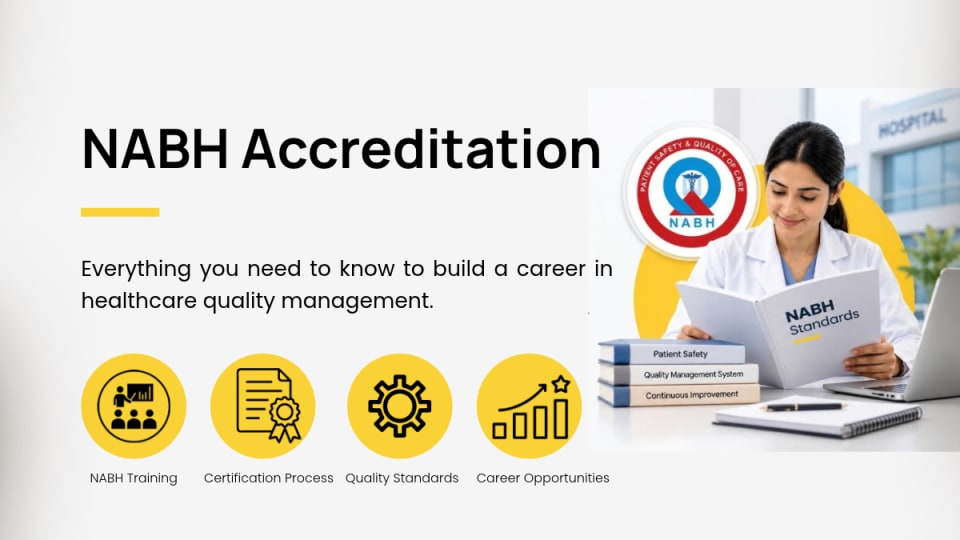
NABH courses are training programs certified by the National Accreditation Board for Hospitals & Healthcare Providers (NABH). These courses equip participants with the skills to implement quality and patient safety across hospitals and other healthcare service delivery organizations.
These courses cover a range from basic quality manager courses to advanced assessor training courses. These courses attract significant interest from the healthcare fraternity, including doctors, nurses, hospital administrators and managers.We have done exhaustive research and a write-up on NABH courses. Our articles cover what an NABH course is, the significance of NABH courses, the various types of courses, eligibility for an NABH course, and career opportunities after completing an NABH course.
What is NABH? Significance of Quality in Healthcare in the Indian Scenario?
National Accreditation Board for Hospitals and Healthcare Providers (NABH) is a constituent Board of the Quality Council of India (QCI). It is responsible for the development and maintenance of quality benchmarks in healthcare and patient safety in India.
In an emerging Indian healthcare system with more demanding customers, greater medical tourism and stricter laws, standardization is important to provide consistently high-quality, safe healthcare.
NABH accreditation is a benchmark that demonstrates an organization's commitment to patient safety and quality healthcare.Some of the benefits of NABH accreditation to a health care organization include, but are not limited to, the following:
- Improved Operational Efficiency and Discipline
- Decreased Patient Safety and Clinical Risks
- Improved Reputation
- Favorable impact on the bottom line and increased patient volumes
While NABH accreditation provides the structure to achieve the desired outcomes, its effectiveness depends on the people implementing them. This is where quality NABH training bridges the gap.
What is an NABH Course?
An NABH course teaches you how to interpret and implement NABH quality standards in a hospital setting. This course suits healthcare professionals at all levels, from students to experienced professionals. Completing the NABH course gives participants an advantage in meeting their organizations' professional requirements.
It takes a long and detailed process for a hospital to gain NABH accreditation. Implementing NABH quality principles in the hospital is equally challenging. It covers all processes related to documenting patient care, infection control and staff training.
After completing professional NABH training, participants gain the skills to manage the NABH accreditation process and train staff on new protocols. They learn how to:
- Interpret the purpose of the NABH standards and chapters;
- Develop actionable policies to implement quality benchmarks; and
- Document and present evidence for accreditation assessment.
They can also identify gaps during internal audits. Lastly, they learn to create a culture of quality improvement within their organization.
Many well-resourced hospitals fail to meet accreditation because they lack trained staff. This is why NABH courses are valuable for participants and their hospitals.
What are the Main Types of NABH Courses?
NABH offers multiple course types. Familiarizing yourself with these types allows you to select the best course in line with your long-term goals and career aspirations.
Quality Managers Certificate Course?
The Quality Managers Certificate Course is geared towards hospital personnel who lead or assist in quality management on a routine basis. The course covers the basics of NABH standards, quality indicators, patient safety goals and the documentation requirements.
This course benefits hospital administrators and managers, quality control officers and other healthcare staff involved in or responsible for the assurance and improvement of quality in healthcare.
What aspects of the Programme on Implementation (POI) cover?
POI looks at the operational aspects of NABH standards in hospitals. It facilitates the shift of participants from the theoretical to the implementation level and ultimately to the preparedness for assessment level. The POI provides participants with the skills to develop necessary procedures and train staff to perform these procedures.
This track is generally taken by people working in hospitals actively pursuing accreditation or by professionals involved in planning or implementing NABH standards at the nursing, infection control and facility management levels.
What is the Goal of the Assessors Training Program?
To perform assessment visits on behalf of the National Association of Boarding Homes (NABH), individuals need to be trained in the skills acquired through this program. Participants of this programme undergo comprehensive training on how to perform assessments against the requirements of accreditation.
This training is designed for professionals with a background in healthcare quality or hospital administration who want to become assessors. Assessors play an important role in accreditation because their judgment determines a hospital's accreditation outcome.
Who Should Take the Specialized Masterclasses?
The Specialized Masterclasses cover different elements of healthcare quality, such as infection control, patient safety and medication management, as well as accreditation standards for different facility types like blood banks and small healthcare organizations.
Masterclasses are specific to employees with a basic knowledge of NABH and who wish to gain more knowledge about a particular aspect of NABH that is pertinent to their role.
Which Course Type is Right for You?
- The Quality Managers Certificate Course is suitable for new entrants to hospital compliance.
- Programme on Implementation (POI) is best for people in the active rollout phase of accreditation in a specific department.
- The Assessors Training Programme is better suited to experienced professionals who want to take on an evaluative, external role.
- Masterclasses are best suited for individuals wanting to enhance their knowledge and skills in a specific quality area.
For hospital quality management, the first-level course is the Quality Managers Certificate Course and/or POI. The Assessors Training Programme is taken after some years of work experience.
Who is Eligible for NABH Courses?
Most NABH courses are targeted at healthcare professionals, both in the clinical and administrative fields. Typically, the following professionals are eligible to attend the courses:
- Doctors who have completed their MBBS or equivalent degree and are interested in taking up quality management and/or administrative roles.
- Nurses involved in patient safety and/or ward-level quality and/or infection control.
- Healthcare administrators, management and other allied health professionals such as lab technicians and pharmacists, provided the course is focused on that particular area.
The Assessors Training Programme is mostly open to individuals with a few years of experience in healthcare quality/Hospital administration and/or who have completed a foundational NABH course. Each course, however, has its specific eligibility criteria.
What Can You Expect in Terms of Career Opportunities Post Completing NABH Training?
A career after completing an NABH course is attractive, as demand for NABH-certified professionals in India's growing healthcare sector is high. More hospitals are opting for accreditation, and the growth of medical tourism and corporate health chains has created this demand. Pursuing an NABH course creates several opportunities:
- Working as a Quality Manager or Quality Coordinator in an NABH-accredited hospital, focusing on maintaining the organization’s compliance and driving continuous improvement.
- Working as an Accreditation Consultant, helping several hospitals achieve NABH accreditation.
- Working as a NABH Assessor, where you are engaged to evaluate hospitals seeking accreditation.
- Working in a corporate healthcare chain focused on adopting standardized quality practices across all facilities.
- Working in medical tourism, where the focus is on providing NABH-accredited facilities for international patients.
As the need to ensure quality in healthcare grows and becomes a priority for hospitals to compete for patients, insurance, and partnerships, NABH-certified professionals with have an edge in the marketplace.
Register for NABH Training Today!
Healthcare quality management is no longer a peripheral or niche function within a hospital. It has become a core function that should be integrated into every aspect of service delivery. NABH training equips candidates with the relevant skills and knowledge to facilitate this transformation.
Whether you are a doctor, a nurse, or an administrator looking to switch into a quality management role, or you are already in a quality management role and seeking new opportunities, NABH offers courses tailored to your aspirations. Consider the types of courses available and consider the ones that match your background and goals most. Then take the lead.
Frequently Asked Questions
Q. How long do NABH courses last?
Course lengths vary based on the content. Some courses last a few days, and others span a couple of weeks. The specific length is provided for each course.
Q. Are NABH certifications only valid in India?
Since NABH has accreditation from ISQua, it has international recognition and is deemed to be equivalent to international standards in quality in health care. This makes NABH-trained personnel and accredited hospitals valuable internationally.
Q. Can non-clinical personnel take NABH courses?
Absolutely. Non-clinical personnel, such as healthcare administrators and managers, can take several NABH courses covering hospital management, documentation and compliance.
