
How to Implement a Quality Management System (QMS) in a Small Laboratory
Published 11 months ago
1. What is a Quality Management System (QMS)?
A Quality Management System (QMS) is the framework that ensures all laboratory activities — from sample collection to report delivery — are performed accurately, safely, and consistently.
It helps your lab:
- Maintain reliability and precision in test results.
- Reduce human and equipment errors.
- Build trust among doctors and patients.
- Achieve compliance with ISO 15189:2022 and NABL standards.
In short, a QMS is not just a set of documents — it’s a culture of doing things right, every single time.
2. Challenges Small Labs Face While Implementing QMS
In small cities like Patna, typical labs face challenges such as:
- Limited staff or no dedicated Quality Manager.
- Lack of awareness about NABL or ISO standards.
- Budget constraints for training or software systems.
- Heavy workload with minimal documentation support.
But here’s the good news — a QMS can be implemented step-by-step, even with minimal resources, as long as there’s commitment to quality.
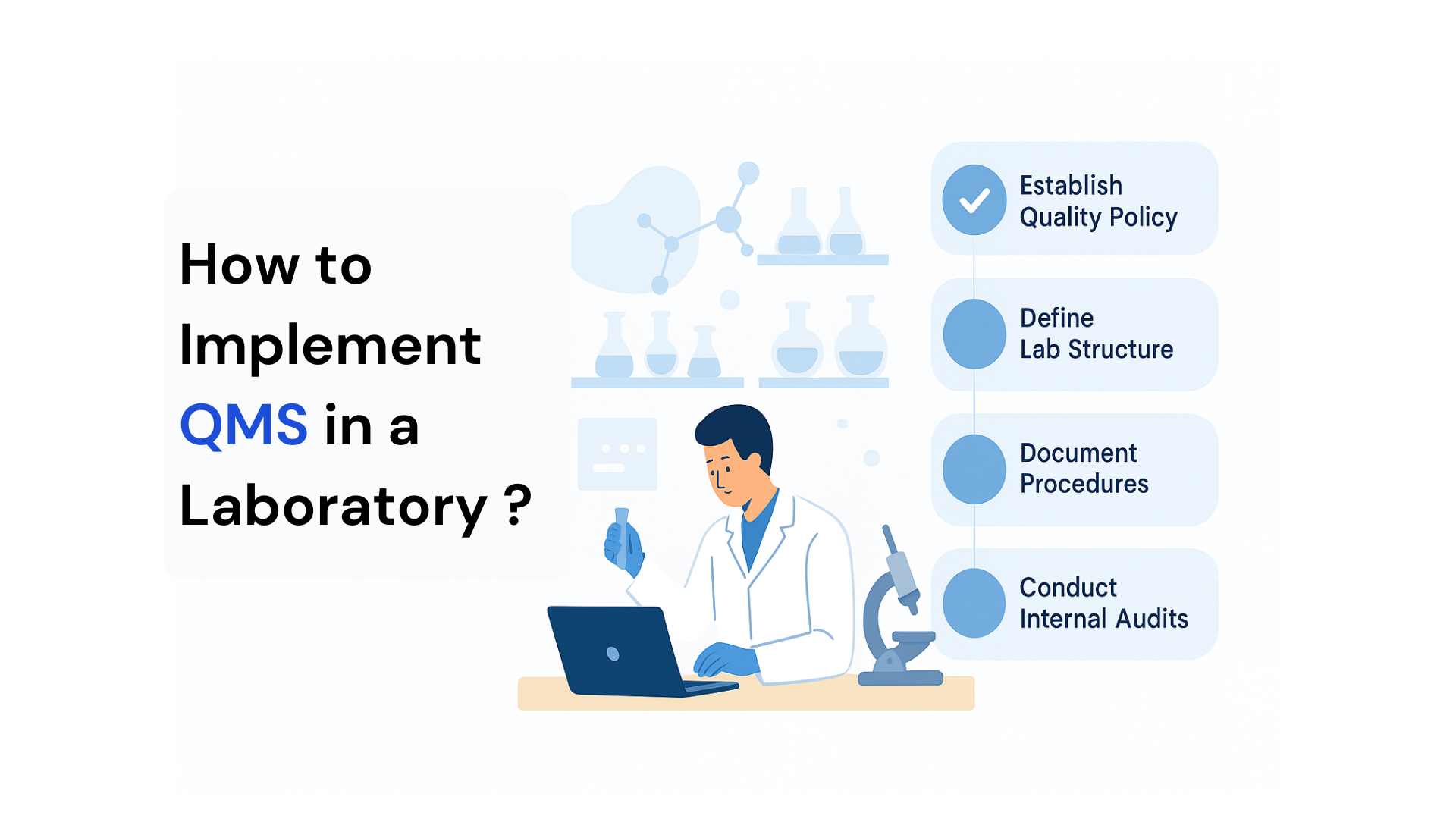
3. Step-by-Step Process to Implement QMS in a Small Laboratory
Step 1: Leadership Commitment and Quality Policy
Everything starts with the Lab Director or Owner.
They must understand that implementing QMS is not an extra cost — it’s an investment
in accuracy and reputation.
✅ Define your Quality Policy
(a short statement reflecting your lab’s commitment to quality).
Example:
“We are committed to delivering accurate, reliable, and timely diagnostic results through continuous improvement and staff competency.”
✅ Define Quality Objectives — make them simple and measurable, e.g.:
- Reduce sample rejection rate below 2%.
- Achieve 100% documentation compliance within 6 months.
Display these visibly in the lab.
Step 2: Define Lab Structure and Responsibilities
Even a small lab must have a clear structure — who is responsible for what.
Create an Organogram showing:
- Lab Director / Technical Head
- Quality In-charge (even part-time)
- Section Heads (Hematology, Biochemistry, Microbiology, etc.)
- Technicians & Sample Collection Staff
Clearly define each person’s roles and responsibilities — especially for:
- Document control
- Equipment maintenance
- Record keeping
- QC & EQA participation
🧩 Tip: In small labs, one person can hold multiple roles, but clarity is key.
Step 3: Documentation System Setup
A QMS is built on documents and records.
Start small — you don’t need fancy software; even organized folders (digital or
hard copy) will do.
Key documents required:
- Quality Manual - overview of your QMS and lab structure.
- SOPs (Standard Operating Procedures) - step-by-step instructions for every process.
- Forms & Registers - for sample collection, maintenance logs, IQC records, complaints, etc.
📁 Create a documentation folder structure:
/Quality Manual
/SOPs
/Forms & Records
/Equipment Logs
/Training & Competency
/Incident & Corrective Actions
Step 4: Resource Management
Even small labs must ensure all resources are qualified and calibrated:
- Manpower:
- Verify staff qualification and provide periodic training.
- Maintain competency records annually.
- Equipment:
- Maintain equipment installation and calibration certificates.
- Create preventive maintenance logs.
- Reagents & Consumables:
- Implement simple inventory control — date of receipt, expiry, and lot number tracking.
- Facility:
- Maintain cleanliness, temperature control, and safety measures (fire extinguisher, PPE, waste disposal).
Step 5: Process Control (The Heart of QMS)
Your daily testing process has 3 stages:
- Pre-Examination Phase:
- Proper sample collection, labeling, and storage.
- Clear SOPs for patient preparation (e.g., fasting, timing).
- Sample rejection criteria must be documented and followed.
- Examination Phase:
- Daily IQC run before patient testing.
- Regular calibration of instruments.
- Use of approved and validated methods only.
- Post-Examination Phase:
- Report verification and authorization.
- Handling of critical values (immediate communication to clinicians).
- Record retention for traceability.
🧩 Tip: Maintain a logbook for every process — it helps during audits and ensures consistency.
Step 6: Quality Control (IQC & EQA)
- IQC: Run daily controls to check precision.
- EQA: Enroll in external programs like AIIMS, CMC Vellore, or NABL-recognized providers to check accuracy.
Record all results and corrective actions taken.
Step 7: Risk Management and Corrective Actions
Under ISO 15189:2022, labs must identify and manage risks proactively.
Examples:
- Risk of power failure → Install UPS or generator.
- Risk of sample mix-up → Implement barcode or double verification.
Maintain a Risk Register documenting:
- The risk identified
- Impact and probability
- Mitigation measures
When any non-conformity occurs (e.g., wrong report, QC failure), record it and mention:
- Root cause
- Corrective action
- Preventive action
Step 8: Internal Audit and Management Review Meeting (MRM)
Once every 6-12 months, conduct an Internal Audit — even if by your own trained quality in-charge.
Check:
- Are SOPs followed?
- Are records complete?
- Are staff trained?
After the audit, hold a Management Review Meeting (MRM) with lab leadership to discuss:
- Audit findings
- Corrective actions
- Quality indicators
- Improvement plans
Document the minutes (MOM) and follow up.
Step 9: Continual Improvement
QMS is not a one-time setup — it’s a living system.
Encourage feedback from staff and clinicians. Track quality indicators such as:
- Turnaround time (TAT)
- Repeated tests
- Sample rejections
- Equipment downtime
Take small actions every month to improve these metrics.
4. Real-World Example: Implementing QMS in a Small Lab in Patna
Let’s say you run a diagnostic lab in Patna with 6-8 staff members.
Here’s how your implementation plan could look:
- Month 1-2: Basic training, create quality policy, define roles, and prepare SOPs.
- Month 3-4: Organize documentation, start daily IQC and inventory logs.
- Month 5-6: Conduct internal audit, join EQA program, and review progress.
- Month 7-8: Submit NABL application (if desired) or continue strengthening QMS.
Even with limited resources, you can implement a functioning QMS that meets national standards — if you start systematically.
5. Final Thoughts
Implementing a QMS in a small lab isn’t about how big your
setup is — it’s about how serious you are about quality.
Once your lab begins to follow these steps consistently, you’ll see:
✅
Fewer errors
✅
More confidence from doctors
✅
Stronger patient trust
✅
Easier NABL accreditation journey
At Qualityveda, we specialize in helping small and mid-size laboratories implement ISO 15189-based QMS practically and affordably — from training and documentation to audit readiness.