
How to Perform Internal Quality Control (IQC) in a Medical Laboratory | ISO 15189, NABL & CLSI Guide
Published 1 month ago
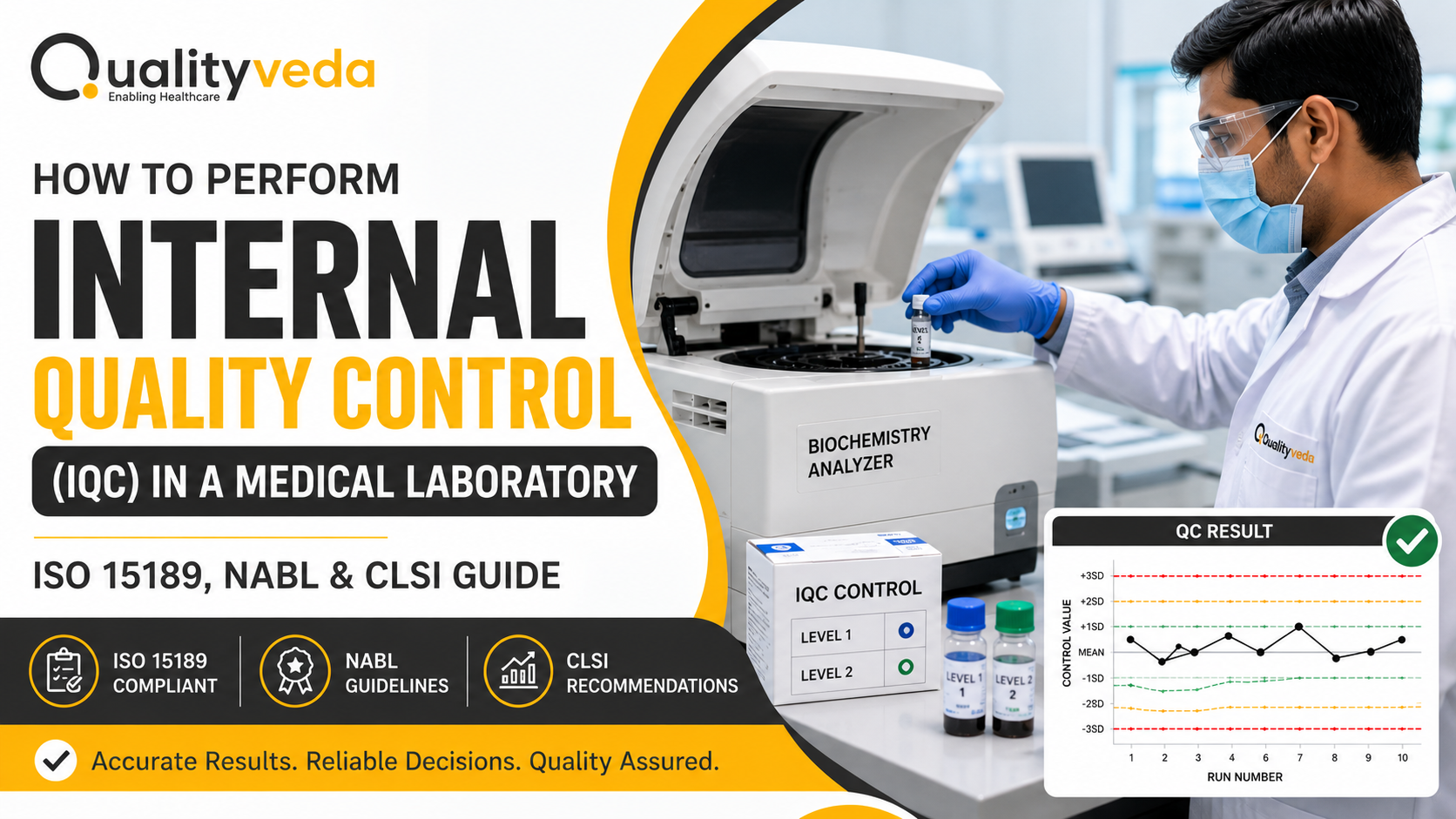
Internal Quality Control (IQC) is a routine process used to monitor the accuracy and precision of laboratory tests. It ensures that patient test results are reliable before they are reported. IQC is a key requirement under ISO 15189:2022, NABL 112, and CLSI guidelines.
Quality Control ensures that laboratory test results are reliable, accurate, and consistent every day.
Why is Quality Control (QC) Performed in a Laboratory?
Quality Control (QC) is performed in medical laboratories to ensure accurate, precise, and reliable test results. It helps detect testing errors, monitor instrument performance, verify reagent quality, and ensure compliance with ISO 15189, NABL, and CLSI guidelines, ultimately protecting patient safety and improving diagnostic accuracy.
Objectives of QC
Ensure Accuracy – Confirms that test results are close to the true value.
Maintain Precision – Ensures consistent results when the same sample is tested repeatedly.
Detect Errors Early – Identifies random and systematic errors before patient reporting.
Monitor Instrument Performance – Verifies that analyzers are functioning correctly.
Check Reagent Quality – Confirms that reagents and calibrators are performing as expected.
Improve Patient Safety – Prevents incorrect diagnoses and inappropriate treatment caused by inaccurate laboratory results.
Meet Accreditation Requirements – Required by standards such as ISO 15189:2022, NABL, and CLSI guidelines.
Maintain Confidence – Ensures clinicians and patients can trust laboratory reports.
Example
Suppose the expected QC value for Glucose is 100 mg/dL (±5 mg/dL).
✅ QC result = 102 mg/dL → Within range → Patient samples can be tested.
❌ QC result = 112 mg/dL → Out of range → Investigate the issue (instrument, reagent, calibration, or operator) before reporting patient results.
QC = Complete quality monitoring system
IQC = Daily internal check to ensure test results are accurate before reporting
Step-by-Step IQC Procedure
1. Select Quality Control (QC) Material
Use commercial QC materials or validated in-house controls.
Choose at least two levels of control:
Level 1 (Normal)
Level 2 (Abnormal/Pathological)
Store and handle QC materials according to the manufacturer's instructions.
2. Prepare QC Material
Reconstitute (if required) as per the manufacturer's instructions.
Label with:
Lot number
Date of preparation
Expiry date
Store at the recommended temperature.
3. Run QC Before Patient Samples
Perform IQC:
At the beginning of each working day or shift.
After calibration.
After reagent lot changes.
After preventive maintenance or instrument repair.
Whenever results appear questionable.
4. Record QC Results
Enter the observed values in:
QC register
LIS (Laboratory Information System)
Excel sheet or QC software
Maintain complete records with:
Date
Time
Instrument
Reagent lot
Operator name
QC values
5. Compare with Target Values
Compare the observed QC result with:
Manufacturer-assigned target value, or
Laboratory-established mean and standard deviation (SD)
6. Plot the Levey–Jennings (LJ) Chart
Plot daily QC values on an LJ chart.
Monitor trends, shifts, and random errors over time.
7. Apply Westgard Rules
Evaluate QC using Westgard rules such as:
1₂s – Warning rule
1₃s – Reject run
2₂s – Reject run
R₄s – Random error
4₁s – Systematic error
10x – Systematic bias
8. Take Corrective Action (If QC Fails)
If QC is outside acceptable limits:
Do not report patient results.
Check:
QC material
Reagents
Calibration
Instrument performance
Pipettes
Environmental conditions
Repeat QC after corrective action.
Document the investigation and corrective actions taken.
9. Release Patient Results
Only report patient results after QC is within acceptable limits.
10. Review QC Trends
Review LJ charts regularly (daily/weekly/monthly).
Identify trends or shifts early.
Take preventive actions before patient results are affected.
IQC Documentation Checklist
✅ QC logbook or LIS records
✅ Levey–Jennings charts
✅ Westgard rule evaluation
✅ Corrective Action Report (CAR)
✅ QC lot records
✅ Instrument maintenance records
✅ Calibration records
Best Practices
Run IQC every day before patient testing.
Use fresh and unexpired QC materials.
Follow the manufacturer's instructions.
Train laboratory personnel on QC interpretation.
Maintain complete documentation for NABL and ISO 15189 compliance.
Participate in External Quality Assessment (EQAS/PT) in addition to IQC.
Reference Guidelines
ISO 15189:2022 – Medical Laboratories – Requirements for Quality and Competence
NABL 112 – Specific Criteria for Accreditation of Medical Laboratories
CLSI C24 – Statistical Quality Control for Quantitative Measurement Procedures
CLSI EP23 – Laboratory Quality Control Based on Risk Management
Advance Your Laboratory Career with Qualityveda
Join Qualityveda's Master NABL Training Program and learn from industry experts. We have professionally trained 1,000+ laboratory professionals, helping them enhance their skills, advance their careers, and achieve better salary growth.
We also offer: NABL Audits, Documentation, ISO 15189 Implementation, and Complete NABL Accreditation Support.
Qualityveda – Your One-Stop Solution for NABL Excellence.
🌐 www.qualityveda.co | 📞 +91 8882509194