
Common Challenges in Maintaining NABL Accreditation and How to Overcome Them
Published 10 months ago
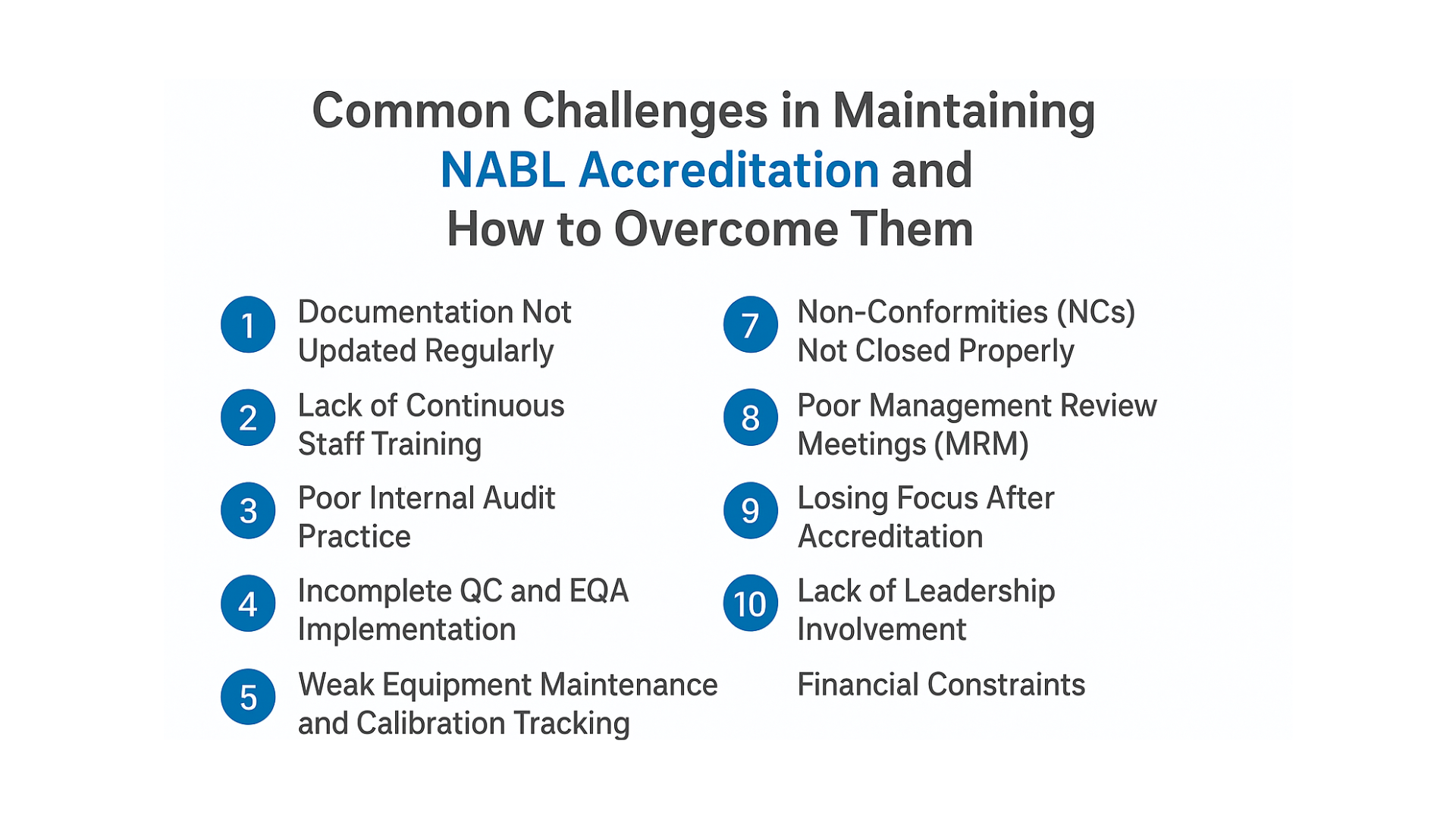
Once your laboratory earns NABL
accreditation, it becomes a symbol of trust, accuracy, and quality.
But NABL expects that your lab continues to operate exactly as per ISO
15189:2022 standards - every single day, not just during audits.
Unfortunately, after initial success, many labs struggle to keep the system alive. Here’s what usually goes wrong - and how to fix it.
1. Challenge: Documentation Not Updated Regularly
The Problem:
Labs often prepare excellent documentation during the initial accreditation
phase - Quality Manuals, SOPs, and records - but fail to keep them updated over
time.
When assessors visit for surveillance, they find:
- Outdated SOPs
- Missing revision control
- No record of version history or authorization
How to Overcome:
✅
Assign one person (preferably the Quality Manager or a trained technician) as Document
Controller.
✅
Schedule a quarterly document review - ensure every SOP, format, and
record reflects the current practice.
✅
Keep digital and physical copies synchronized with revision numbers and
approval signatures.
🗂 Pro tip: Use a simple Excel sheet to track document name, version, and last review date.
2. Challenge: Lack of Continuous Staff Training
The Problem:
After accreditation, training programs often stop. New employees join, old ones
forget procedures, and eventually staff are unaware of updated requirements.
Assessors may ask simple questions like:
“What do you do if IQC fails?”
“Where is the critical alert list displayed?”
If staff can’t answer confidently - it’s a red flag.
How to Overcome:
✅
Conduct monthly refresher sessions (15–30 minutes each) on topics like
sample handling, QC interpretation, or equipment maintenance.
✅
Maintain training attendance and evaluation records.
✅
Include new joiners in an induction training within their first week.
📘 Remember: Training isn’t an expense - it’s insurance for your quality system.
3. Challenge: Poor Internal Audit Practice
The Problem:
Some labs conduct internal audits just for formality, or worse, skip them
altogether.
This leads to unrecognized non-conformities and surprises during NABL assessments.
How to Overcome:
✅
Conduct at least one comprehensive internal audit per year.
✅
Cover all sections - Pre-Examination, Examination,
and Post-Examination.
✅
Record findings, assign corrective actions, and track closure timelines.
✅
Rotate auditors or get external experts (like Qualityveda) for unbiased
reviews.
🎯 Pro tip: Treat internal audits as opportunities for improvement, not fault-finding.
4. Challenge: Incomplete QC and EQA Implementation
The Problem:
Many labs neglect daily Internal Quality Control (IQC) or fail to
participate consistently in External Quality Assessment (EQA) programs.
Missing records or delayed submissions often result in major NCs.
How to Overcome:
✅
Run IQC daily for all tests, document results, and take corrective
action if out of control.
✅
Enroll in a recognized EQA program (AIIMS, CMC, NABL-approved).
✅
Analyze EQA performance reports and record corrective actions taken.
📊 Remember: NABL expects not just participation but evaluation and action on every QC and EQA cycle.
5. Challenge: Weak Equipment Maintenance and Calibration Tracking
The Problem:
Labs sometimes forget calibration due dates or fail to maintain equipment logs.
Assessors check for traceability and find:
- No calibration certificates
- Expired maintenance records
- Incomplete instrument logs
How to Overcome:
✅
Maintain an Equipment Master List - with details of model, serial
number, calibration date, next due date, and AMC/CMC.
✅
Keep preventive maintenance records signed by the service engineer and
lab in-charge.
✅
Label every instrument with its calibration status and date.
⚙️ Tip: Set calendar reminders for calibration and service schedules.
6. Challenge: Non-Conformities (NCs) Not Closed Properly
The Problem:
After internal or external audits, labs often record non-conformities but fail
to close them with proper root cause and evidence.
Assessors then find repeated NCs in follow-up visits.
How to Overcome:
✅
Record every NC in an NC Register.
✅
Write the root cause, corrective action, preventive action, and attach
evidence.
✅
Review NCs during Management Review Meetings (MRM).
✅
Use the “5 Why”
method to identify the true cause - not just
the symptom.
7. Challenge: Poor Management Review Meetings (MRM)
The Problem:
Many labs treat MRMs as paperwork only - short meetings with no real analysis.
As a result, top management is unaware of actual performance gaps.
How to Overcome:
✅
Conduct MRMs twice a year (minimum once).
✅
Review all required topics mentioned in ISO 15189:2022 -
audit results, complaints, feedback, resources, quality indicators, NC status,
etc.
✅
Record both Review Inputs and Review Outputs clearly.
✅
Assign action items and timelines, and review progress in the next meeting.
🧾 Pro tip: MRMs are your chance to get management support for budget, manpower, and equipment upgrades.
8. Challenge: Losing Focus After Accreditation
The Problem:
After receiving accreditation, many labs relax. The initial enthusiasm fades,
and QMS gradually weakens.
By the time of surveillance, documentation is outdated, and staff are
unprepared.
How to Overcome:
✅
Treat NABL accreditation as a journey, not a destination.
✅
Keep quality as a daily routine, not an annual activity.
✅
Monitor Quality Indicators monthly (TAT, sample rejection, customer
complaints).
✅
Keep reminding your team that accreditation represents trust - not just
a certificate.
9. Challenge: Lack of Leadership Involvement
The Problem:
Sometimes, lab owners or directors consider quality management as “the Quality
Manager’s job only.”
Without leadership involvement, QMS activities lose authority and importance.
How to Overcome:
✅
The Lab Director must participate in MRMs, approve documents, and
encourage continuous improvement.
✅
Leadership should promote a culture of quality - where accuracy matters
more than speed.
✅
Recognize staff who maintain good quality practices -
motivation drives consistency.
10. Challenge: Financial Constraints
The Problem:
Smaller labs often worry about the cost of maintaining accreditation -
training, calibration, EQA fees, or audits.
How to Overcome:
✅
Prioritize what’s mandatory - calibration, QC, EQA, and documentation.
✅
Optimize resources - one trained person can manage
multiple quality functions.
✅
Join shared training programs like Qualityveda’s Quality Specialist
Program to get expert guidance at affordable cost.
Final Thoughts: Sustaining NABL Accreditation is About Culture
Maintaining NABL accreditation is not about passing audits - it’s about sustaining quality every single day.
The key is discipline, documentation, and continuous
improvement.
If you embed these into your daily operations, NABL renewal will no longer feel
stressful - it will become routine.
At Qualityveda, we help laboratories not just achieve NABL accreditation but maintain it confidently year after year through structured QMS support, training, and quality audits.
Because real quality is not built once - it’s maintained every day.