NABL Accreditation Documents Checklist 2026 for Labs
Published 13 Nov 2026
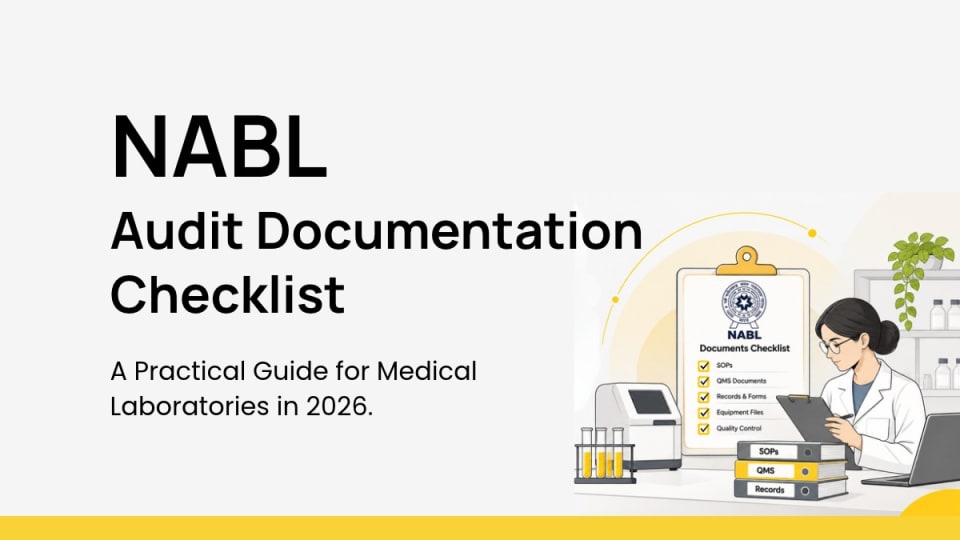
NABL Accreditation Documents Checklist 2026
Introduction
A medical lab must demonstrate technical competency, produce accurate and reliable results and have an effective quality management system in place.
NABL ensures that a medical laboratory has quality and competence according to ISO 15189:2022.
Documentation is an important aspect of the accreditation. A lab needs to document processes, technique records, quality control records, staff records and proof that the QMS is being implemented.
We have included the key documents required below.
1. NABL Accreditation
Ensures the laboratory has the competency to perform certain tests.
Medical laboratories are judged against the ISO 15189:2022 and NABL requirements.
Medical Laboratories will be able to demonstrate:
- Competent Staff
- Accurate Examination Process
- Effective Quality Control
- Properly Managed Equipment
- Traceable and Documented
- Continuous Improvement
For further details on the process, please see Qualityveda’s Complete Step-by-Step NABL Accreditation Process.
2. NABL Accreditation Documents Checklist 2026
Medical Laboratories will need to develop documentation relating to their examination processes.
The following is a list of the main documentation categories.
S. No. | Category | Key Documents |
1 | Legal | Registration Certificates & Licenses |
2 | Quality Management | Quality Manual, Policies & Objectives |
3 | Staff | Qualifications, Job Description & Competency |
4 | Equipment | Equipment List, Calibration & Maintenance |
5 | Examination Techniques | SOPs, Verification & Validation |
6 | Internal Quality Control | IQC Records, Levey-Jennings Chart & CARs |
7 | External Quality Assessment | PT/EQA Records & Reports |
8 | Pre-Examination | Sample Collection & Transport |
9 | Post-Examination | Reports, Critical Alerts & Amended Reports |
10 | Risk Management | Risk Assessment & Risk Mitigation Records |
11 | Internal Audit | Audit Plan, Observations & Corrective Actions |
12 | Management Review | Decisions & Action Plan |
This is a helpful guide when creating your documentation. This should not be used as a substitute for the official NABL application and assessment checklists.
An effective documented process is only useful if the lab can show it to be effective.
5. Staff & Training Records
Competence of laboratory personnel is crucial to the reliability of laboratory examination results.
Laboratories should retain records of:
- Staff members' qualifications and experience.
- Appointment and authorization.
- Job descriptions.
- Attendance at training.
- Effectiveness of training.
- Assessment of staff members' competence to perform their duties.
- Continuing education.
- Authorized signatories.
Staff should be trained and authorized to perform the activities for which they are appointed.
6. Equipment and Calibration Documents
Equipment records show that the instruments used in examination activities are suitable for the purpose.
Equipment Documentation Checklist
- Equipment master list.
- Installation and acceptance records.
- Equipment identification.
- Calibration certificates, if applicable.
- Preventive and corrective maintenance records.
- Performance verification of equipment.
- Records of monitoring of temperature and environmental conditions.
Calibration and maintenance should be done as per the prescribed requirements and schedules.
7. Examination SOPs and Method Verification Documents
Laboratories must retain approved SOPs for their examination activities.
Each examination SOP should be detailed enough for the method to be performed by trained personnel.
The supporting records may include:
- Manufacturer's Instructions for Use (IFU).
- Method verification or validation records.
- Precision studies.
- Accuracy or bias studies.
- Range of Analytical Measurement verification.
- Linearity studies, if applicable.
- Verification of reference intervals.
- Measurement uncertainty, if applicable.
The studies required depend on the examination method and its intended use.
For added guidance, see Validation Study References, Qualityveda.
8. Internal Quality Control (IQC) Documents
Internal Quality Control is performed to evaluate the ongoing validity of laboratory examination results.
Some important records include:
- Results of IQC.
- QC material information and lot information.
- Established control limits.
- Levey-Jennings charts.
- Westgard rule evaluations, when appropriate.
- Investigations of QC failures.
- Records of corrective actions.
- Trends in quality control.
Laboratories can use software to assist in the preparation of Levey-Jennings charts. For example, Qualityveda's QCurve is one such software.
Records of external quality control (EQC)
The performance of external quality assessment (EQA) schemes is one of several ways to evaluate the performance of a laboratory.
Laboratories must retain records of their:
- Enrollment and participation in EQA/PT schemes.
- Results submitted to EQA schemes.
- Performance reports from EQA schemes.
- Investigations of unacceptable performance.
- Corrective actions.
- Effectiveness reviews of corrective actions.
Appropriate alternative arrangements should be documented in the absence of adequate EQA schemes.
Records documenting activities that occur before and after the examination
Pre-Examination
- Test request forms.
- Procedures to positively identify the patient.
- Procedures for collecting samples.
- Criteria for accepting or rejecting samples.
- Procedures for transporting and storing samples.
Post-Examination
- Procedures to review and authorize test results.
- Methods used to communicate test results.
- Turnaround time (TAT) reviews.
- Amended reports.
- Procedures for retaining or disposing of samples.
These procedures assist laboratories in maintaining traceability of the examination process.
Internal Audit and Management Review
Internal audits and management reviews help laboratories evaluate their quality management systems. Important documents for these reviews include:
- Internal audit schedule.
- Audit checklist.
- Findings of an audit and nonconformities.
- Root cause analysis.
- Corrective action plans.
- Review of the corrective action.
- Management review agenda and minutes.
- Action plans and follow-up records.
Laboratories should conduct relevant evaluations to identify and eliminate deficiencies prior to the assessment.
Important documents published by NABL for 2026
Laboratories should be aware of the most recent official publications of NABL.
NABL Document | Purpose |
NABL 100A | General Information Brochure |
NABL 100B | Accreditation Process and Procedure |
NABL 112A | Specific Criteria for Accreditation of Medical Laboratories |
NABL 112B | Guidance Document: Medical Laboratories |
NABL 131 | Terms and Conditions for Accreditation |
NABL 153 | Application Form for Medical Testing Laboratories |
NABL 208A | Pre-Assessment Guidelines and Forms |
NABL 220D | Document Review Checklist for ISO 15189:2022 |
NABL 223 | Assessment Forms and Checklist for ISO 15189:2022 |
Laboratories should confirm the latest issues and amendments.
Preparing for NABL Accreditation: 13 Common Documentation Problems
- Outdated SOPs and uncontrolled documents.
- Evidence of training and competency is missing.
- Records are incomplete. (Equipment records, IQC records, EQA records, internal audits, management reviews)
- Documentation to support method verification is missing.
- Nonconformities from internal audits are not corrected.
- Evidence of effectiveness of corrective actions is missing.
- Inconsistencies exist between proposed accreditation scope and records.
- Documentation gaps are not evident during regular quality system documentation reviews.
Frequently Asked Questions
Q1. What documents are necessary for NABL Accreditation?
Quality management documents (SOPs, records of equipment, personnel, IQC, EQA, management reviews, internal audits)
Q2. What is a quality manual?
Although there is no NABL requirement for a quality manual, a quality manual is a way to organize management system documentation. Therefore, a quality manual is referenced in NABL application guidance.
Q3. Is IQC documentation required?
Yes, medical laboratories must perform IQC and retain documentation to evaluate the ongoing validity of examination results.
Q4. Are Internal Audits Required Before NABL Assessment?
Internal audits are a part of the evaluation of the laboratory’s management system and support the readiness of the laboratory for assessment.
Q5. Which Standard Applies to NABL Medical Laboratories in 2026?
The international standard ISO 15189:2022 and the NABL-specific criteria and guidelines are applicable in this case.
Conclusion
There are various advantages to maintaining proper, precise and controlled documentation. It is required during the inspection as evidence and for other activities such as managing personnel, system activities and quality.
A checklist of NABL Accreditation Documents helps laboratories organize different types of documentation and supports the laboratory in preparation for an NABL Accreditation.
Laboratories, by following the requirements of NABL and ISO 15189:2022, have the potential to demonstrate their competence and further enhance the trust in patient examination results.
NABL Accreditation Support by Qualityveda
For NABL accreditation, ISO 15189:2022 and other associated requirements, including development of SOPs, verification of methods, staff training and maintenance of quality management documentation, Qualityveda offers thorough assistance and support to the laboratories.
Website: https://qualityveda.co/
NABL Consultancy: https://qualityveda.co/nabl-consultancy
Phone: +91 88825 09194
We at Qualityveda offer a wide range of services, including assistance with obtaining NABL accreditation, to help laboratories uphold and improve their quality.
