NABL Training: ISO 15189 Course for Laboratory Professionals
Published 26 Nov 2026
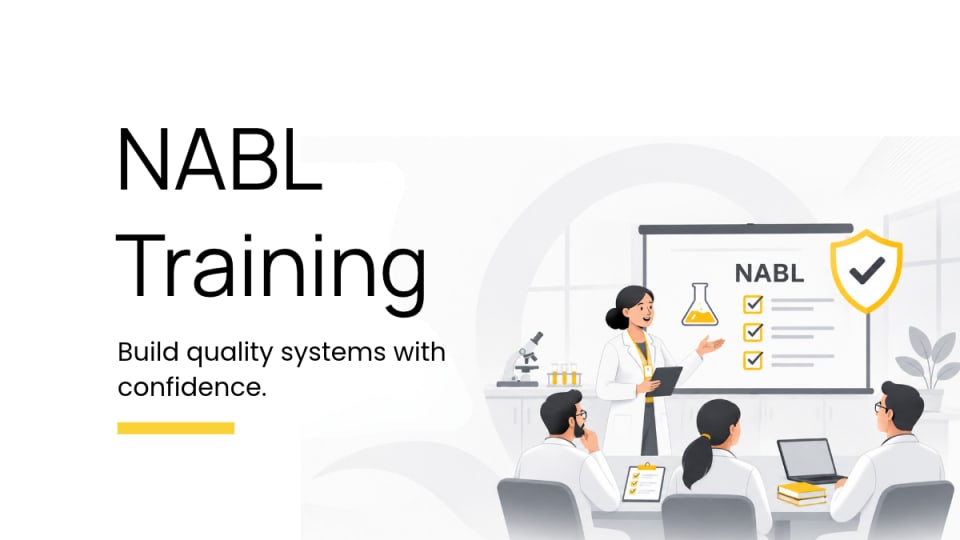
NABL Training: ISO 15189 Course for Laboratory Professionals
NABL training refers to educational and capacity building programs that enable those working within a laboratory to gain awareness of accreditation standards, quality management systems, and applicable technical requirements. Typically for medical laboratories, training is provided in relation to ISO 15189:2022 and the application of the standard.
Delivering dependable laboratory testing requires more than state-of-the-art instrumentation and proficient personnel. The operational foundation relies on robust quality management systems, standardized methodologies, skilled personnel, and thorough document control. Undertaking structured NABL training assists personnel in clarifying accreditation standards while reinforcing routine analytical operations.
ISO 15189:2022 is recognized as the quality and competence standard within Indian healthcare settings. Good knowledge and understanding of this standard enables laboratory staff to exceed minimum requirements and ensure that high-quality, reproducible, and prompt testing can be provided.
What Is NABL Training?
Training and development is used to educate professionals on NABL accreditation, quality, and relevant technical areas.
Typically for medical laboratories, training often involves education on ISO 15189:2022 and how it should be used. Personnel are then able to understand and value how the standard can be implemented in the laboratory, staff and testing, as well as in quality and development.
Alongside this, NABL also conducts technical training through the Quality Council of India. Again, these aim to enhance knowledge of standards and accreditation awareness but do not seek to offer laboratory-specific consultancy services.
Why Is NABL Training Important for Medical Laboratories?
Whilst producing suitable documentation is a key part of becoming accredited, laboratory personnel must understand why procedures exist and how to implement them consistently.
Accreditation requires solid documentation, yet it is equally important that laboratory staff understand why these processes exist and how to implement them.
A structured NABL accreditation training program can help laboratories:
- Understand and apply ISO 15189:2022.
- Enhance document and data management.
- Develop both internal and external quality assurance.
- Recognize and manage risks within the laboratory.
- Raise staff understanding of, and proficiency at, carrying out their roles.
- Support internal and external auditing and accreditation processes.
Staff will then incorporate adherence to the quality system in their routine work rather than just prior to assessments.
For further information on accreditation documentation, laboratories can refer to the NABL Documents section.
Key Topics Covered in an ISO 15189 Training Course
Topics covered in a training program on ISO:15189
Ideally a training program relating to ISO:15189 will relate theory to practice within laboratories. Topics to be covered are:
| Topic | Information provided |
|---|---|
| ISO 15189:2022 | Details of structure and relevant clauses |
| Quality Management System | Control of documents, record keeping, and processes |
| Personnel Competence | Training, approval, and assessment of personnel competencies |
| Equipment | Calibration, servicing, and performance |
| Internal Quality Control | Assessment and investigation of performance |
| External Quality Assessment | Information about EQA and proficiency testing |
| Internal Audits | Audit design, observation, and reporting |
| Management | Risk recognition of risks together with action to resolve them |
Such information enables laboratory staff to recognize the relationship between quality and both patient care and laboratory reporting.
Who Should Attend NABL Training?
NABL and ISO 15189-related training can benefit professionals involved in laboratory quality and technical operations, including:
- Directors and heads of laboratories.
- Quality managers and quality officers.
- Pathologists and laboratory heads.
- Medical laboratory technologists and technicians.
- Auditors and staff.
- Students and those graduating in life sciences who wish to pursue a career in laboratory quality management.
The appropriate course will be determined by a person's background, job role, and objectives.
How to Choose the Right NABL Training Course
There are varying levels of learning provided on courses that promote themselves as providing NABL training. Consider:
Standard coverage: Does the training include ISO 15189:2022 (for medical laboratories) and/or ISO/IEC 17025:2017 (for testing and calibration laboratories)?
Practical Learning: Seek out training that includes practical elements such as case studies, document production, and audit-related topics.
Instructor knowledge: Ideally, the instructor should have appropriate expertise in laboratory quality management and accreditation.
Course Format: Investigate how long the training will last, together with options for online or face-to-face delivery. Further, explore the assessment and support available.
Certification: Be clear about the significance of the certificate and recognize if this is for participation or completion of training. Having a certificate evidences someone has undertaken a training scheme but does not in itself mean they are accredited or are an assessor empanelled by NABL.
Build Your Laboratory Quality Expertise with Qualityveda
Develop your laboratory quality knowledge with Qualityveda.
Qualityveda delivers a four-day live virtual training program, which enables laboratory staff to gain an in-depth understanding of NABL and ISO 15189:2022 and then apply that knowledge to their medical laboratory quality environment. Learners are also asked to complete a test and will receive a certificate upon successful completion.
Whether you are a laboratory member of staff or a quality manager, structured training can enable you to better understand and therefore confidently manage laboratory quality.
To find out further information about Qualityveda’s NABL and ISO 15189 Training Program, please visit our website.
Explore the Qualityveda NABL & ISO 15189 Training Program to learn more.
You can also explore Qualityveda NABL Consultancy for information about laboratory accreditation support.
Frequently Asked Questions:
1. Why undertake NABL training?
Training is conducted to equip staff with knowledge of accreditation, quality, and the processes that enable laboratories to be competent.
2. Is ISO 15189 training suitable for pathology laboratories?
Yes. Quality and competency requirements are defined in medical laboratory settings by ISO 15189:2022. As a result, this training has particular relevance to pathologists and diagnostic laboratories.
3. Can I become an NABL assessor having undertaken ISO 15189 training?
No. Undertaking a generic ISO 15189 training programme does not automatically make you a NABL assessor. An independent recruitment and training process is in place for NABL assessors.
4. Who can undertake ISO 15189 training?
This can be undertaken by laboratory staff, quality personnel, technicians, students, and life scientists. Courses can be tailored to an individual’s educational background and experience.
Conclusion
Training staff in NABL is key to producing a competent, quality-focused laboratory. Through awareness of ISO 15189:2022, continued professional development and consistent application of quality procedures, laboratory staff can therefore support the provision of more accurate testing and improve patient care.
Whilst it is important to train for an accreditation visit, the ultimate aim is to instil a culture within a laboratory whereby high standards of quality are routinely upheld.