
Internal Quality Control (IQC) vs External Quality Assessment (EQA) - What’s the Difference?
Published 11 months ago
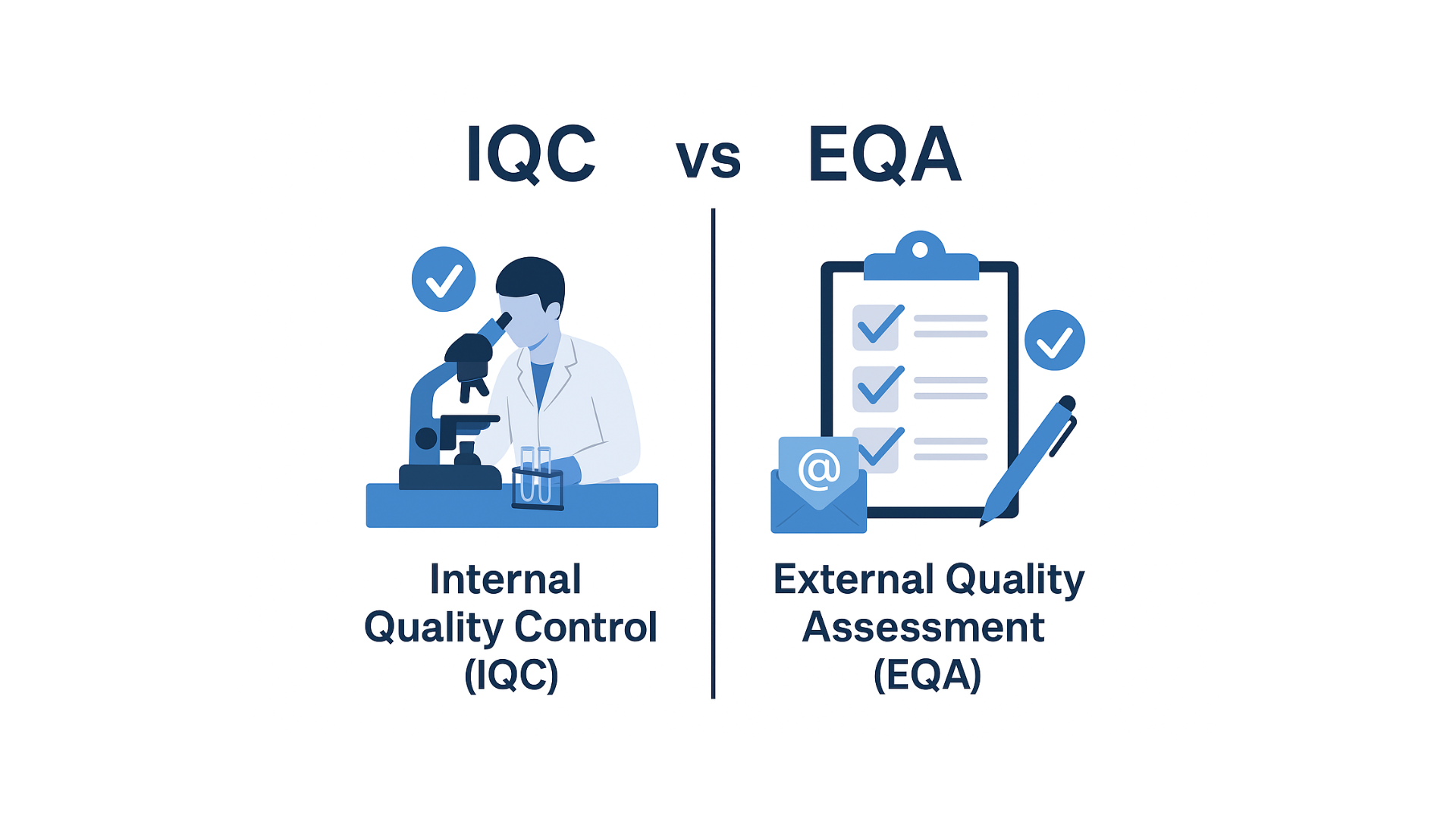
In every diagnostic laboratory, maintaining quality and consistency in test results is not just important - it’s mandatory. Even the most advanced instruments and trained staff can produce inaccurate results if the quality system isn’t monitored regularly.
To ensure reliable test performance, laboratories follow two
essential quality practices:
👉
Internal Quality Control (IQC) and
👉
External Quality Assessment (EQA).
Though both aim to maintain accuracy, they differ in purpose, frequency, and evaluation methods.
Let’s understand each in detail.
1️⃣ What is Internal Quality Control (IQC)?
Definition:
Internal Quality Control (IQC) is a daily process performed within the
laboratory to check the precision and stability of test
results.
In simple words:
In IQC, the lab uses control materials with known values. When these are tested
along with patient samples, the lab compares the obtained results with the
expected values. If results match the expected range, it indicates that the
instrument, reagent, and process are functioning correctly.
Purpose of IQC:
- To monitor the daily performance of equipment and reagents.
- To identify any sudden shift or drift in results.
- To ensure results are precise and reproducible.
Example:
Suppose your biochemistry analyzer is testing glucose levels.
You run an IQC sample where the known glucose value is 100 mg/dL. If
your analyzer also reports around 100 (within acceptable limits), your system
is performing well.
Frequency:
✅
IQC should be performed daily, or even more frequently (e.g., per shift
or per batch) depending on workload and test criticality.
Key Parameters Checked in IQC:
- Precision (Repeatability)
- Stability of equipment performance
- Detection of analytical errors
What if IQC Fails?
If IQC results fall outside acceptable limits:
- Stop reporting patient results.
- Investigate the cause (reagent issue, calibration, or instrument malfunction).
- Take corrective action and re-run IQC before resuming testing.
2️⃣ What is External Quality Assessment (EQA)?
Definition:
External Quality Assessment (EQA), also known as Proficiency Testing (PT),
is an independent evaluation of a lab’s performance by an external
agency.
How It Works:
- EQA providers send blind samples to participating labs.
- The lab processes these samples exactly like patient samples.
- The lab submits its test results back to the EQA provider.
- The provider compares your results with peer laboratories (labs using the same method or instrument).
- You receive a performance report showing your lab’s accuracy in comparison to others.
Purpose of EQA:
- To assess accuracy (trueness) of test results.
- To identify systematic errors across labs.
- To ensure your lab performs at par with national and international standards.
Frequency:
✅
EQA is conducted periodically, usually 3–4 times per year,
depending on the provider’s schedule.
Example:
If your lab reports a serum sodium value of 138 mmol/L for an EQA sample, but
the peer mean is 140 mmol/L, your result deviation is analyzed statistically.
This helps you understand if your system consistently gives slightly lower (or
higher) results - indicating bias.
3️⃣ Key Differences Between IQC and EQA
|
Feature |
Internal Quality Control (IQC) |
External Quality Assessment (EQA) |
|
|
Purpose |
To monitor precision and stability of daily lab performance |
To check accuracy compared to other labs |
|
|
Frequency |
Daily or per batch |
Periodic (Monthly, Quarterly or as per schedule) |
|
|
Who Conducts It |
Laboratory staff |
External accredited provider |
|
|
Samples Used |
Known control samples |
Blind samples (unknown values) |
|
|
Evaluates |
Instrument, reagent, and operator consistency |
Overall lab performance & method accuracy |
|
|
Type of Error Detected |
Random or immediate errors |
Systematic or long-term bias |
|
|
Required By |
ISO 15189:2022 (Clause 7.3.7) |
ISO 15189:2022 (Clause 7.7) |
|
4️⃣ Why Both IQC and EQA Are Important
Both IQC and EQA complement each other - one checks daily precision,
and the other ensures overall accuracy.
Together, they create a complete quality loop that maintains trust in
every test result your lab produces.
In short:
- IQC ensures that your analyzer is running fine today.
- EQA ensures that your analyzer’s results are comparable with the rest of the world.
Without regular IQC and EQA participation, a lab cannot demonstrate technical competence or achieve NABL accreditation.
5️⃣ Final Thoughts
Implementing both IQC and EQA is not just about meeting compliance requirements - it’s about building a culture of quality, accuracy, and patient trust.
At Qualityveda, we help laboratories set up strong internal QC systems, select the right EQA providers, and train staff to interpret and act on QC data effectively.
If your lab aims to achieve or maintain NABL accreditation, understanding and properly implementing IQC & EQA is the foundation.